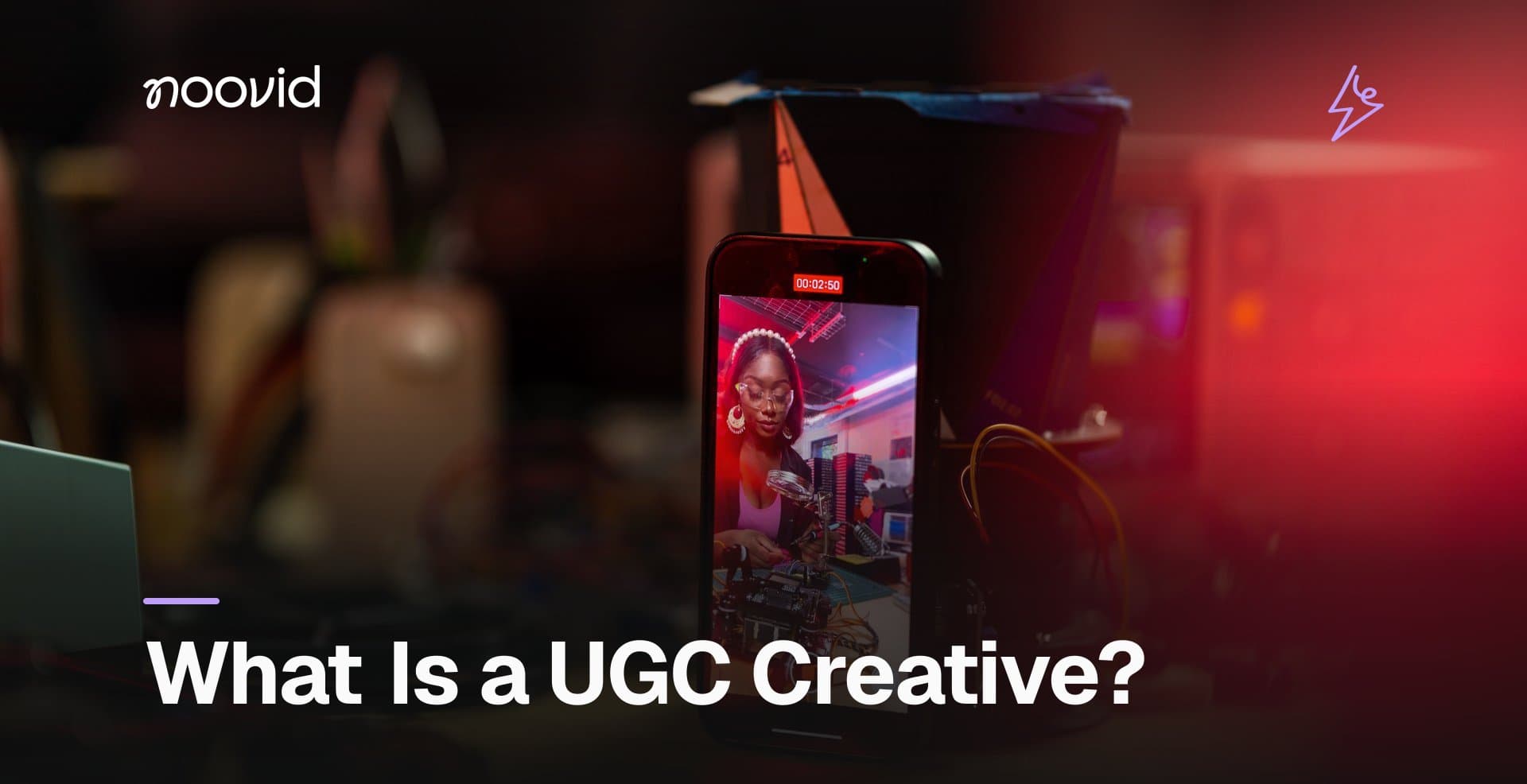
In performance marketing, the "creative" is the ad asset itself: the video, image, or copy that runs in a campaign. A UGC creative is a real-person-style video, filmed by a creator, used as a paid ad on Meta, TikTok, and other channels. It is commissioned content, scripted, built to look spontaneous on purpose.
The confusion comes from the word "creative." In everyday use it is an adjective. In paid media, "a creative" is a noun: the asset a brand uploads to a campaign. When a media buyer says they want to "test more creatives," they mean more ad versions, not more ideas.
What a UGC creative actually is
A UGC creative combines two things. The look of UGC, which mimics the homemade video of an ordinary customer, and the job of a performance creative, which is to sell inside a paid ad.
In practice it is a short, usually vertical video where someone talks to the camera, shows the product, and drives an action. It feels like an organic post, but it was made to order, with a brief, a script, and usage rights for paid media.
That is the distinction buyers care about. A UGC creative is not a lucky post that went viral. It is a predictable asset, commissioned to run in a campaign and judged by results.
The anatomy of a creative that converts
A good UGC creative is not a loose monologue. It has a structure, and every part has a job.
Hook (the first 1 to 3 seconds). This is what keeps someone watching before they scroll past. It can be a line, a problem said out loud, or a close-up of the product. It is the most decisive part and the one most often tested. If you want to understand why those seconds set up everything else, read how to create UGC that sells in the first 3 seconds.
Problem. Right after the hook, the video names the viewer's pain. The phone that is always dead, the skin that flakes in winter, the finance app nobody understands.
Product demonstration. Here the creator shows the product solving that problem. It is not the brand talking about itself. It is someone using it, testing it, pointing at the detail that matters.
Proof or objection handled. The part that dismantles doubt. A genuine before and after, an "I thought it was expensive, but," a simple comparison with what the viewer already uses.
CTA. The call to action at the end: download, buy, take the offer. Without it, the video entertains and does not convert.
The order can shift, but these five pieces show up in most creatives that perform. Where the video runs changes the tone of each one. Building a creative for Meta Ads that truly converts is not the same as one made for TikTok Ads, which cannot look like an ad.
Why the media buyer asks for ten creatives
If you have ever heard "I need ten variations of the same video," here is the logic.
Ads wear out. After a few days running, the same creative starts performing worse because the audience has already seen it. This is called creative fatigue, and the only fix is having fresh versions ready to swap in.
Beyond wear, there is testing. The buyer keeps the same body of the video and swaps only the hook, to find out which opening grabs the most people. Then they take the winner and build new variations on top of it, changing one detail at a time.
That is why the demand is never for one perfect video. It is for a batch of variations to test and replace. For the brand, that means budgeting a campaign around volume. For the creator, it means a variation pack is a product in itself, often more profitable than selling one-off videos.
A UGC creative is not the same as an organic post
The style is identical. The purpose and the rights are not.
An organic UGC post lives on a profile, with no ad spend behind it, and usually comes with more limited usage. A UGC creative becomes paid media, and paid media needs clear usage rights in the contract: how long the brand can run it, on which platforms, whether it can edit and recut. Ignoring this is the mistake that costs the most money, on both sides.
There is a variation called whitelisting: the ad runs from the creator's own account, with their name and face, which raises the sense of authenticity. It is a separate right that has to be agreed and priced in the brief, never assumed.
For brands: the brief decides the creative
A shallow creative almost always starts with a shallow brief. If you want a video that converts, the brief has to give the creator four things.
- Product: what it is, how it works, which detail to show.
- Audience: who this ad speaks to, and in what language.
- Main objection: the number one doubt that blocks the purchase.
- Format: where it runs, length, orientation, the exact CTA.
With that, the creator can build the hook, demonstration, and proof aimed in the right direction. Without it, you get a pretty video that does not sell. If you want a starting point, use a UGC brief and script template and adapt it to your product.
For creators: the creative is the best-selling format
Of all UGC formats, the paid creative is what brands buy most and what pays best. Delivering a nice unboxing is easy. Delivering a video that holds attention in three seconds, names the right objection, and ends on a clear CTA is what separates creators who charge little from creators who charge well.
Mastering that anatomy is, in practice, your competitive edge. It is what lets you offer variation packs, charge for usage rights, and get booked again. If you are building that base now, the guide on how to become a UGC creator in Brazil shows the path before you sell your first creative.
Frequently asked questions
What does "creative" mean in paid traffic?
In paid media, "creative" is the ad asset: the video, image, or copy a brand uploads to a campaign. It is not about being creative in the everyday sense. It is the asset the audience actually sees, and the thing the buyer tests and optimizes to get results.
What is the difference between a UGC creative and a traditional ad?
A traditional ad tends to have polished production, professional voiceover, and an advertising look. A UGC creative imitates a real person's video, shot on a phone, to blend into the feed and avoid being ignored. Both are paid ads, but UGC wins on the feeling of authenticity.
How many creatives does a campaign need?
There is no magic number. It depends on the budget, how fast the audience saturates, and how many hypotheses you want to test. The logic is simple: the more hook variations you test, the faster you find what works, and the more replacements you need once the winner starts to tire.
Who makes the creative: the brand or the creator?
Both take part. The creator films the video from the brief. The brand, or an editor, sometimes cuts variations and adjusts captions and CTA on top of that footage. Who can edit and reuse the video depends on the usage rights set in the brief, so agree on that before filming.

Written by
Noovid Team
The Noovid editorial team: UGC specialists who work hands-on with vetted creators and brands worldwide every day. We turn what's working into practical guides for getting content that sells.